
Homestead on the hill
Simple & delicious gluten-free food.
This post contains affiliate links. If you purchase through these links, I may earn a small commission at no extra cost to you.
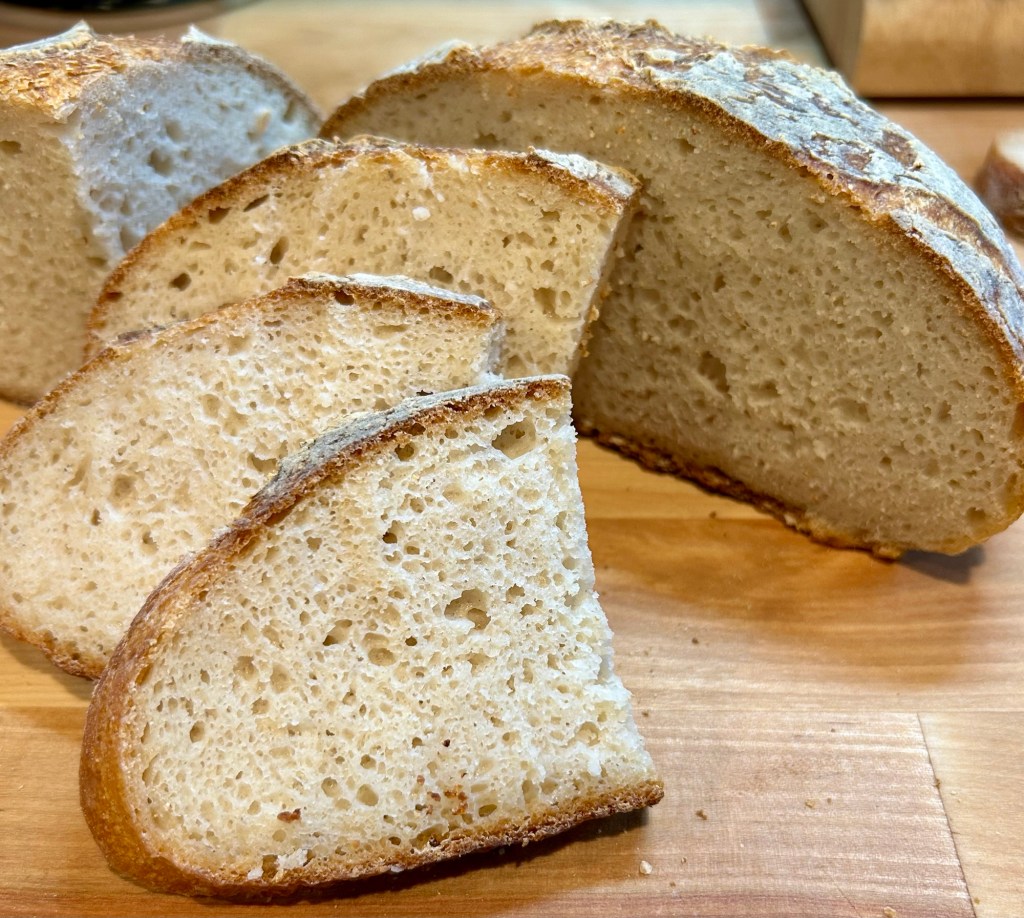
Both apple cider vinegar (ACV) and baking powder can improve rise in gluten-free sourdough, but they work through very different mechanisms. One supports fermentation and texture, while the other provides a controlled chemical lift.
How Baking Powder Works in Gluten-Free Sourdough
Baking powder is a complete leavening system.
It contains:
- A base (baking soda)
- One or more acids
- A starch buffer (to prevent premature reaction)
Most baking powders are double-acting, meaning they release carbon dioxide twice:
- When hydrated
- Again when exposed to heat in the oven
What that means for your loaf:
- CO₂ gas is produced regardless of the dough’s acidity
- The second release in the oven gives gluten-free dough a reliable oven spring
- Structure sets quickly, helping the loaf hold its shape
Results you’ll see:
- Taller, more rounded loaf
- Improved rise consistency
- Better structure and sliceability
- Less sour flavor, because baking powder buffers acidity rather than enhancing it
👉 Baking powder is especially helpful in gluten-free sourdough where fermentation alone often isn’t strong enough to create height.
How Apple Cider Vinegar (ACV) Works in Gluten-Free Sourdough
ACV does not directly create gas. Instead, it works by acidifying the dough, which impacts both fermentation efficiency and crumb texture.
What that means for your loaf:
- Acid strengthens starch gels and hydrocolloids (like psyllium husk)
- Yeast activity is supported in a slightly acidic environment
- Gas produced during fermentation is retained more effectively
Results you’ll see:
- Softer, more tender crumb
- Improved dough cohesion
- Slightly less vertical rise compared to baking powder
- More robust sour flavor, since ACV adds acidity rather than buffering it
👉 ACV enhances how fermentation behaves, not how much gas is produced.
Flavor Differences: Tangy vs. Mild
Baking powder → less sour loaf
The built-in acids and buffers temper overall acidity, yielding a milder flavor.
ACV → deeper sourdough tang
Adds acetic acid directly, intensifying sour notes.
This makes baking powder ideal for those who want the look of sourdough without an aggressive sour bite.
Shape & Texture Comparison
| Feature | Baking Powder | ACV |
| Gas Production | chemical (double-acting) | fermentation only |
| Oven Spring | strong & reliable | moderate |
| Shape | taller, rounder | slightly flatter |
| Crumb | structured, stable | softer, more tender |
| Flavor | mild | tangy, sour |
When to Use Each in Gluten-Free Sourdough
Baking Powder Loaf – slightly taller, rounder loaf with a tighter structure & crumb.

ACV loaf– slightly flatter loaf with a softer texture & crumb.
Use baking powder if you want:
- A taller, domed loaf
- Predictable rise
- Mild sourdough flavor
- Better sandwich bread structure
Use ACV if you want:
- A softer crumb
- More pronounced sour flavor
- Improved fermentation behavior
- Artisan-style texture
You can even intentionally use both:
ACV to support fermentation and crumb softness, and a small amount of baking powder to ensure height and roundness.
In gluten-free sourdough, success comes from balancing fermentation chemistry and structural support. Baking powder provides dependable lift, while ACV fine-tunes flavor and texture. Knowing how each works lets you control the final loaf instead of relying on trial and error.
Now the next step is to learn how to manipulate your fermentation time to work for YOU! Whether you need to speed it up or slow it down, you have control. Learn next about how to manage your fermentation time with temperature.
Want more ad-free and printable sourdough tips and gluten-free recipes? Join my email list here and they’ll be sent straight to you.
If you need in-depth step-by-step instructions to start baking incredible gluten-free sourdough bread be sure to grab my Gluten-free Sourdough Beginner’s Guide. Delicious bread is right ahead!
One response to “ACV vs. Baking Powder in Gluten-Free Sourdough: What’s the Difference?”
[…] *For a taller, more firm, mild-tasting loaf, use baking powder. For a softer, more sour-tasting loaf, use apple cider vinegar. I have an in-depth explanation of each choice in this post. […]